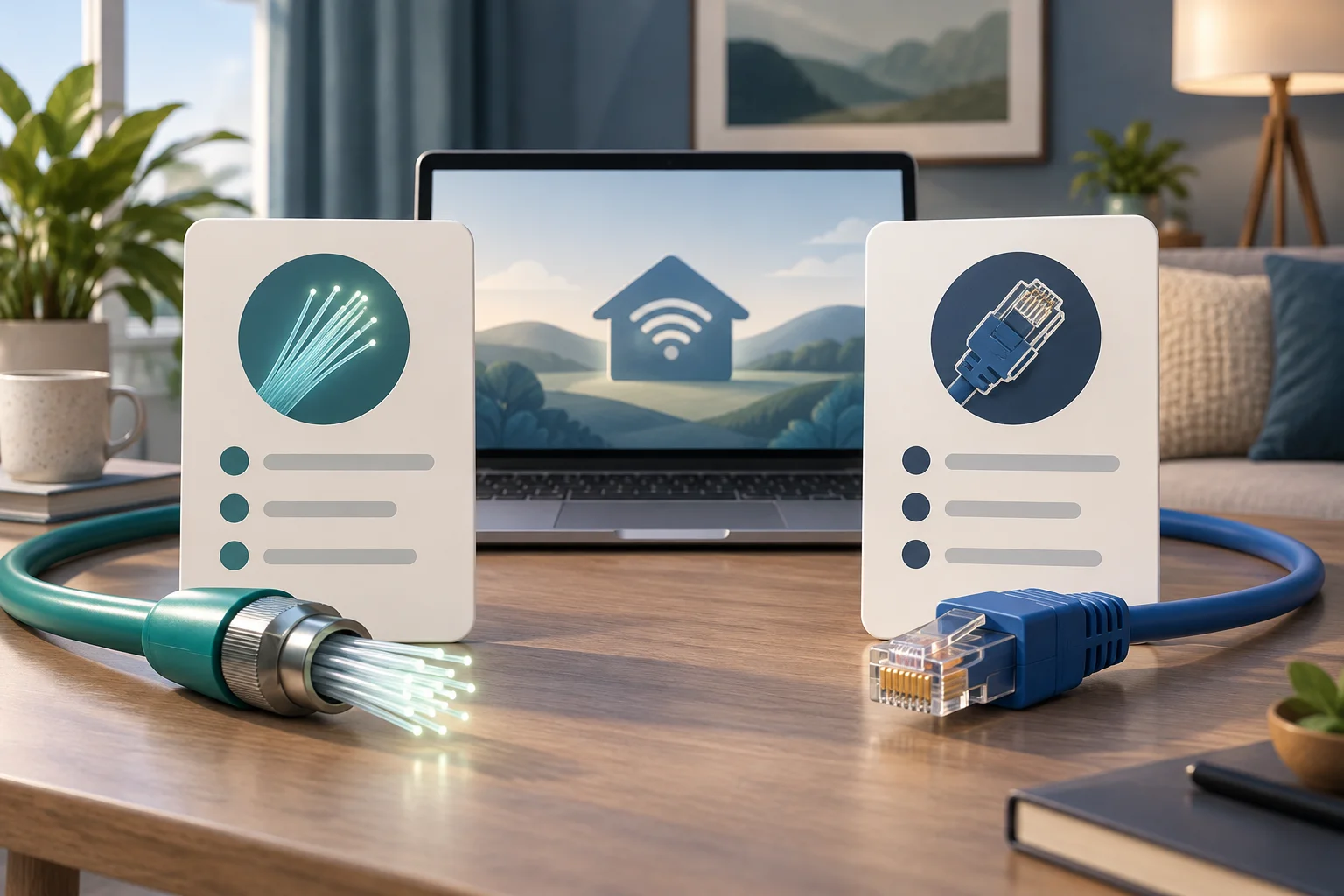
Choosing between fiber and cable internet is one of the most important decisions you can make for your home connectivity. Both technologies deliver fast, reliable internet, but they work in fundamentally different ways — and those differences matter for speed, reliability, latency, and long-term value. This guide breaks down everything you need to know to make the right choice.
How Fiber Internet Works
Fiber internet transmits data as pulses of light through thin glass or plastic strands called optical fibers. Each strand is about the diameter of a human hair, yet it can carry enormous amounts of data at nearly the speed of light. A single fiber optic cable contains multiple strands bundled together, providing massive bandwidth capacity.
The fiber signal travels from your ISP to an optical network terminal (ONT) installed at your home, which converts the light signals into electrical signals your router and devices can use. Because light signals don't degrade over distance the way electrical signals do, fiber delivers consistent performance regardless of how far you are from the provider's hub.
Major fiber providers include Google Fiber, Verizon Fios, and AT&T Fiber, with regional providers expanding rapidly across the country.
How Cable Internet Works
Cable internet uses the same coaxial copper cables that deliver cable television. Data travels as electrical signals through the coaxial lines from your ISP to a modem in your home. The technology standard used is called DOCSIS (Data Over Cable Service Interface Specification), with the latest version being DOCSIS 4.0.
Cable infrastructure is shared among neighborhoods, meaning the bandwidth available to your home is split among nearby subscribers. This shared architecture can result in slower speeds during peak usage hours when many people in your area are online simultaneously.
Leading cable providers include Xfinity, Spectrum, and Cox, which collectively cover the majority of U.S. households.
Speed Comparison: Fiber vs Cable
Fiber internet offers a significant advantage in raw speed potential and, critically, in upload speeds.
Download Speeds
Both fiber and cable can deliver gigabit download speeds. Fiber plans commonly offer symmetrical speeds of 1 Gbps, 2 Gbps, and even 5 Gbps or higher. Cable internet tops out at around 1.2 Gbps with DOCSIS 3.1 technology, though most cable plans max out at 1 Gbps.
Upload Speeds
This is where fiber truly shines. Fiber connections are typically symmetrical, meaning your upload speed matches your download speed. A 1 Gbps fiber plan gives you 1 Gbps both down and up. Cable internet, by contrast, allocates far less bandwidth to uploads — typically 10 to 35 Mbps on most plans, with premium plans reaching 100 to 200 Mbps.
Upload speed matters more than ever for video conferencing, cloud storage, live streaming, uploading large files, and smart home devices that send data continuously.
Speed Comparison Table
| Feature | Fiber | Cable |
|---|---|---|
| Max Download Speed | 5-10 Gbps | 1-1.2 Gbps |
| Typical Upload Speed | Symmetrical (matches download) | 10-35 Mbps (most plans) |
| Speed Consistency | Very consistent | Can slow during peak hours |
| Latency | 1-10 ms typical | 15-30 ms typical |
Reliability and Consistency
Fiber internet is generally more reliable than cable for several reasons. Fiber optic cables are immune to electromagnetic interference (EMI), which can affect copper coaxial cables. They're also less susceptible to weather-related disruptions and signal degradation over distance.
Cable internet's shared infrastructure means your speeds can drop during peak usage hours — typically evenings and weekends when neighbors are streaming, gaming, and downloading. Fiber's dedicated connection to your home doesn't suffer from this congestion effect.
That said, cable internet has matured significantly and is reliable enough for most households. The performance gap is most noticeable in densely populated areas where cable networks are heavily subscribed.
Latency: Why It Matters for Gaming and Video Calls
Latency (also called ping) is the time it takes for data to travel from your device to a server and back. Lower latency means faster response times, which is critical for real-time applications.
Fiber typically delivers latency of 1 to 10 milliseconds, while cable ranges from 15 to 30 milliseconds. For casual use, this difference is imperceptible. But for competitive online gaming, real-time video conferencing, and trading platforms, fiber's lower latency provides a noticeable advantage.
Jitter — variation in latency — is also lower on fiber connections, resulting in smoother video calls and more consistent gaming experiences.
Pricing Comparison
Fiber internet pricing has become increasingly competitive. Entry-level fiber plans start around $30 to $50 per month for 300 Mbps, with gigabit plans typically running $60 to $80 per month. Some fiber providers offer multi-gigabit plans for $100 to $180 per month.
Cable internet plans start at similar price points — $30 to $50 for 200-300 Mbps. Gigabit cable plans typically cost $80 to $100 per month. However, cable providers more commonly increase prices after promotional periods end and may charge equipment rental fees of $10 to $15 per month.
When comparing total cost of ownership, fiber often comes out ahead because many fiber providers include equipment at no extra charge and offer simpler, more transparent pricing without as many hidden fees.
Availability
This is cable's biggest advantage. Cable internet is available to roughly 88% of U.S. households, compared to approximately 57% for fiber (as of 2026). Cable infrastructure was built out decades ago for television, giving it a massive head start.
However, fiber availability is expanding rapidly thanks to federal broadband funding programs and private investment. Many areas that only had cable options a few years ago now have fiber alternatives. You can check what's available at your specific address using our availability checker.
For a deeper comparison of technology types, see our fiber vs cable technology comparison.
Which Should You Choose?
Choose fiber if it's available at your address and fits your budget. The symmetrical speeds, lower latency, and superior reliability make it the better technology overall. It's especially worth it if you work from home, game competitively, or have a large household with many connected devices. Browse top fiber providers to see options in your area.
Choose cable if fiber isn't available at your address, or if you're looking for a lower-cost plan with adequate performance for general use. Cable internet at 200 to 500 Mbps is more than enough for most households. Explore our best cable providers for recommendations.
The Future of Both Technologies
Fiber's future is bright — literally. The technology has a clear upgrade path to 10 Gbps, 25 Gbps, and beyond with equipment upgrades alone (the fiber itself doesn't need replacing). DOCSIS 4.0 will push cable speeds higher, but the shared architecture and upload speed limitations remain fundamental constraints.
As remote work, cloud computing, and bandwidth-hungry applications continue to grow, the advantages of fiber's symmetrical speeds and dedicated connections will become even more pronounced.
Speed Consistency: Where Fiber Dominates
The raw speed numbers tell only part of the story. The real advantage of fiber over cable is consistency — and this matters more than peak speed for everyday use.
Cable speed variability: Cable internet uses a shared network architecture (DOCSIS) where bandwidth is split among homes in your neighborhood node, typically serving 100-500 households. During peak hours (7-10 PM when everyone streams), real-world cable speeds can drop 20-40% below advertised rates. A cable plan advertising 500 Mbps might deliver 300-400 Mbps during evening hours.
Fiber speed consistency: Fiber-optic connections use dedicated strands of glass that carry light signals. While fiber networks use shared splitting at the neighborhood level (typically 32-128 homes per splitter), the total capacity of a fiber connection is so high that congestion is rarely an issue. A 500 Mbps fiber plan typically delivers 480-510 Mbps regardless of time of day.
This consistency is why fiber providers can confidently display their "typical" speeds on FCC broadband labels — they are nearly identical to the advertised speeds. Cable providers' typical speeds are often 60-85% of the advertised maximum.
Upload Speed: Fiber's Biggest Practical Advantage
If you work from home, create content, or use cloud services extensively, upload speed may be the single most important factor in your decision:
- Fiber upload speeds: Most fiber plans offer symmetrical speeds — 500/500 Mbps, 1000/1000 Mbps, etc. This means your upload speed equals your download speed.
- Cable upload speeds: Due to the asymmetric design of DOCSIS technology, cable upload speeds are typically 1/10th to 1/30th of download speeds. A 1 Gbps cable plan may offer only 35-50 Mbps upload. Newer DOCSIS 4.0 technology will improve this, but widespread deployment is still 2-3 years away.
Real-world impact: uploading a 5 GB video file takes approximately 80 seconds on a 500 Mbps fiber upload connection. On a cable connection with 20 Mbps upload, the same file takes over 33 minutes. For regular large file transfers, this difference is transformative.
Reliability and Maintenance
Fiber-optic cables are inherently more reliable than coaxial cable:
- Weather resistance: Fiber-optic cables are immune to electromagnetic interference, including lightning. Coaxial cable can be affected by electrical interference, water infiltration, and temperature changes.
- Signal degradation: Fiber signals can travel much longer distances (up to 40 km for GPON) without degradation. Coaxial cable signals degrade over much shorter distances and require amplifiers (nodes) every few hundred meters.
- Lifespan: Fiber-optic infrastructure has an expected lifespan of 25-50 years and can be upgraded to faster speeds with equipment changes at each end — the fiber itself does not need replacement. Cable infrastructure requires more frequent maintenance and eventual replacement.
- Power requirements: One important caveat — fiber requires powered equipment (an ONT) at your home. During a power outage, fiber internet goes down unless you have battery backup. Cable modems also need power, but traditional copper phone lines (DSL) could work without home power. Both fiber and cable are equally affected by power outages in practice.
When Cable Is Actually the Better Choice
Despite fiber's technical advantages, cable internet is the right choice in several scenarios:
- Fiber is not available: This is the most common reason. Cable networks cover approximately 85% of US homes, while fiber covers roughly 50%. If fiber is not available at your address, cable is typically the next best option.
- Your needs are modest: If you primarily stream video and browse the web with 1-3 people, a 200-300 Mbps cable plan delivers an excellent experience at a potentially lower price than fiber. The consistency advantage of fiber is less noticeable at these moderate speeds.
- Cable is significantly cheaper: If the cable option is $30-$40/month less than fiber in your area, the savings may outweigh the performance difference for light-to-moderate users. Providers like Spectrum offer competitive cable pricing with no data caps.
- Short-term housing: Cable providers often offer no-contract plans with easy installation. If you are in temporary housing for 3-6 months, the flexibility of no-contract cable may be more convenient than fiber, which sometimes requires more involved installation.
For a detailed comparison of providers at your address, use our address lookup tool to see both fiber and cable options available to you.
Frequently Asked Questions
Is fiber internet worth the extra cost over cable?
For most users, yes — especially since fiber pricing has become very competitive with cable. The extra value comes from symmetrical upload speeds, lower latency, more consistent performance during peak hours, and no equipment rental fees with many providers. If you work from home, stream content, or have multiple users, the difference is noticeable.
Can cable internet be as fast as fiber?
Cable can match fiber's download speeds up to about 1 Gbps. However, cable cannot match fiber's upload speeds (typically 10-35 Mbps vs symmetrical gigabit on fiber) or its latency performance. Cable also suffers from congestion during peak usage hours, while fiber does not.
How do I know if fiber is available at my address?
Check directly with fiber providers in your area (AT&T, Verizon Fios, Google Fiber, local providers) or use our availability tools to see all options at your address. Fiber availability is expanding rapidly, so even if it wasn't available last year, it may be now.
Does fiber internet require special equipment?
Fiber requires an optical network terminal (ONT) to convert the fiber optic signal, which your provider installs at no charge during setup. You'll also need a router, which many fiber providers include for free. The ONT is typically a small box mounted on an exterior or interior wall near where the fiber enters your home.
Is fiber or cable better for gaming?
Fiber is better for gaming due to lower latency (1-10 ms vs 15-30 ms) and lower jitter. Competitive gamers benefit the most. However, cable internet is perfectly adequate for casual gaming — the latency difference is rarely the deciding factor in typical gameplay.
Will 5G home internet replace fiber and cable?
5G home internet is a growing alternative, but it's unlikely to replace fiber or cable for most users in the near term. 5G speeds and latency vary significantly by location, and the technology is better suited as a competitive alternative rather than a full replacement for wired connections.
Sources & Methodology
This article uses data from FCC Broadband Data Collection reports, U.S. Census Bureau demographics, and verified provider pricing and plan information. Pricing, speeds, and availability are verified against provider broadband nutrition labels and may vary by location. For a detailed explanation of our data collection and scoring process, see our methodology page.
Data Sources
- FCC Broadband Data Collection
- U.S. Census Bureau American Community Survey
- USAC Universal Service Fund
- NTIA Internet Use Survey
Last verified: March 2026. InternetProviders.ai is an independent resource. We may earn commissions from partner links — this does not affect our editorial recommendations. See our methodology for details.